Buying A Used Semi Trailer? An Inspector's 8-Point Walkaround (and 3 Reasons To Walk Away)
Leave a message
Last month a buyer in Dar es Salaam sent us photos of a "barely used" 2019 flatbed he had picked up at auction-fresh paint, new tyres, a price that looked like a steal. Three weeks later, a cracked main beam left it parked on the shoulder of the A-109, and the repair quote came back at nearly half what he had paid. The crack was there the day he inspected it. He simply did not know where to look.
Having handed over thousands of units, our yard crew has turned that hard-won lesson into a fixed routine: roughly 45 minutes, no specialist equipment-just walking the trailer in the same order every time. The same routine fits a used unit before you commit to buying it, a fresh shipment you are collecting at the port, and a trailer that has sat unused through an entire rainy season. Keep a flashlight, a pair of gloves and a small hammer to hand. Here is the route to follow.

1. Do the paperwork before you get your hands dirty
Start with the data plate, not the paint. Read the VIN and build date off the chassis plate and confirm they match the registration documents; "barely used" means very little on a unit whose plate has been swapped. Then step straight back ten metres and look at how the trailer sits. A lean to one side usually points to a collapsed suspension or bent axle. Any puddle of gear oil, brake fluid or water under the air tanks after the unit has stood overnight is a clue you can read for free.
2. Kneel at the front and work the main beam with your fingers
Fresh paint is the cheapest disguise in the business, so ignore the colour and focus on the steel. Run your hand along the main beam's upper and lower flanges, the web, and the gooseneck-to-frame junction. You are feeling for hairline cracks, rippled or bowed sections (a sign of repeated overload), and the uneven bead of a fresh repair weld. Tap the frame with the hammer-solid steel rings, while rust-scale or a patched plate sounds dull. Surface rust is cosmetic; pitting, flaking scale, or a floor you can press a finger through, is structural.
3. Crouch at the axles and the suspension
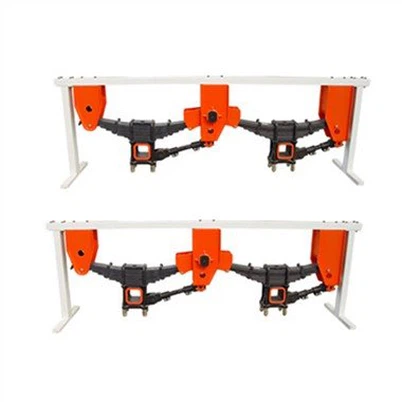
This is where most of the money hides. Sight down each semi trailer axle from behind: a sideways bow, or tyres that don't sit square, means a bent beam or a frame out of alignment. Blue or straw-coloured brake drums signal repeated overheating; oily streaks running from the hub onto the drum mean a failed seal and contaminated linings. Jack one side and rock the wheel-clunking or obvious play points to worn bearings. On the running gear, count the leaves in each semi trailer suspension stack for broken or displaced leaves, check air bags for cracks and patched blisters, and feel the U-bolts and shackle bushes for slack.

4. Charge the air and listen
Connect the glad hands and pump the air system up to full pressure, then shut it off and stand still for two minutes, listening. A constant hiss points to a leaking hose or coupling, the very fault that leaves you frozen with locked brakes on a cold morning. Open the drain cocks on the air tanks-more than a cup of water is a warning that maintenance has lapsed and internal rust has already begun. Work the brake pedal a few times and watch that every brake chamber pushes out and comes back in unison, while a chamber that stays extended means the slack adjuster is seized. At key-on the ABS warning light should illuminate and then switch off. End by reading the lining through the inspection holes, since worn shoes are the one defect a seller will never admit to.
5. Circle the tyres and the rims
Tread depth alone tells you little. Circle every tyre and inspect the sidewalls for bulges, weathering cracks and cuts deep enough to expose the cords. Feathered tread or a shoulder rubbed smooth on one edge signals an axle or alignment fault, not a faulty tyre. Flag any mixed sizes, mismatched load ratings or mixed wheel types. Next examine the rims for cracks around the bolt holes and check each lug nut for a rust streak, the tell-tale sign of a fastener coming loose.
6. Walk the deck and test every lock
On a flatbed or skeleton, run every twist lock through its complete range by hand; a seized, welded or missing pin is a container waiting to move on the road. Walk the deck looking for rotten planks, thin steel and patched-over holes. On stake and side-wall models, open each hinge, latch and side gate, since the doors that merely appear closed are the ones that fly open at 80 km/h.
7. Check the three things buyers forget: kingpin, legs, lights
Kneel at the front and inspect the kingpin for wear flats, weld spatter and a loose or cracked bolster plate-this is the single most loaded joint on the trailer. Crank the landing gear up and down to feel for a stripped gearbox, then plug in the lighting and test every lamp, indicator and reflector in turn. None of these are expensive to fix, but they are the easiest to confirm. If anything is worn, source the correct trailer parts before you pay, not after.

8. Ask for the history the trailer carries
A used trailer keeps a record even when the seller doesn't. Ask for maintenance invoices, the last brake inspection, and any accident or tip-over history-tip-over and overload damage in particular hides behind straightened panels and fresh paint. Confirm the spare wheel, crank handle and wheel chocks are present, since these are the pieces that disappear first.
Three faults that mean walk away
Plenty of "faults" are simply deferred maintenance-tyres, lamps, shoes, hoses and bushes are cheap to renew. The three below are not:
- A cracked main beam, a frame pitted through with rust, or extensive fresh re-welding at the gooseneck. Structural steel rarely returns to its original strength after a field repair.
- A bent axle, or a frame out of alignment that is already scrubbing tyres. This is a system fault, not one worn part, and it will eat every tyre you fit.
- A VIN or data plate that doesn't match the paperwork, combined with brakes that cannot be made to hold pressure. You cannot licence it legally or safely, and you cannot prove where it came from.
Fix it, or walk to a new one?
Calculate the full cost before negotiating. Provided the only requirements are consumable parts and the purchase price is sufficiently low, acquiring the unit and rebuilding it with original components is a well-founded choice. But if even one deal-breaker is present, or the reconditioning quote climbs past roughly 60–70% of a new unit, the "bargain" has already vanished. A purpose-built new trailer-whether a flatbed semi trailer, a lowbed for heavy machinery or a dump unit for site work-leaves the yard with full-pressure brakes, certified steel and a standing supply of spares, which is exactly what survives long hauls and monsoon seasons.
Quick walk-around checklist (save this)
VIN matches the paperwork; trailer stands square; no fluid on the ground
Main beam, gooseneck and welds free of cracks, fresh repair beads or flaking rust
Axles run true; drums not heat-blued, hubs dry, bearings without play
Spring leaves intact; air bags uncracked; U-bolts snug
Air system keeps pressure and stays silent; brakes return in sync; ABS light works
Even tyre wear, no sidewall bulges, sound rims and tight lug nuts
Deck solid; every twist lock, hinge and gate operates smoothly
Kingpin, legs and lights tested; maintenance records in hand
Not sure whether to fix or replace?
Send us the photos, the VIN and the faults you found, and our team will tell you honestly whether the unit is worth reconditioning or whether you are better off ordering new. If you are building a fleet for a specific route, tell us your cargo, axle limits and road conditions, and we will return a dimensioned layout and a quotation rather than a catalogue link.
If you are interested, please contact us any time.