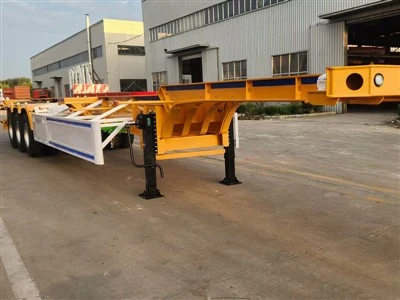
The Last 100 Kilometres: Moving 70-Metre Blades Up To A Brazilian Ridge
Leave a message
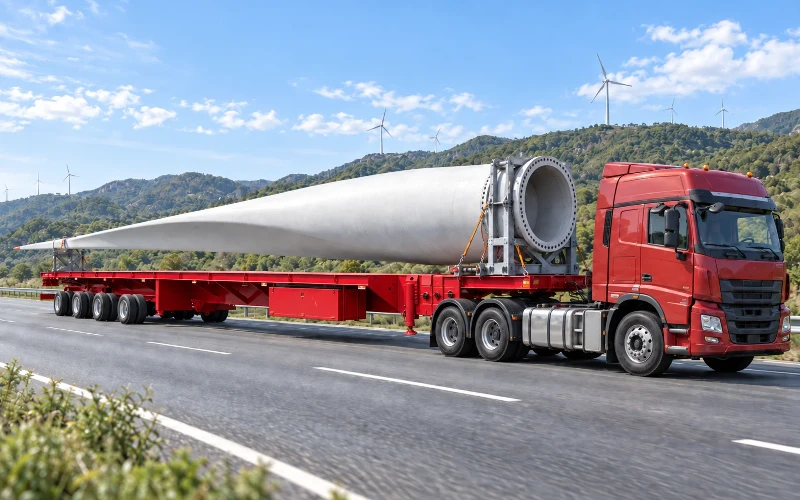
Of all the kilometres a turbine blade travels, the ocean crossing is the easy one. It rolls out of a factory in China, sails halfway across the world and docks at a Brazilian port without a scratch. The difficult miles begin on land: hauling a blade more than 70 metres long through small towns and up a gravel track to the concrete pad waiting on a windy ridge. Anyone can ship steel across the sea; the wind farm is built in that final leg.
The six units in our latest order are built for exactly that stretch. The buyer is a Brazilian heavy-logistics specialist serving the wind parks of Bahia and Rio Grande do Norte, where new turbines keep going up on inland plateaux while the blades arrive through the ports of the northeast. Each machine is a wind blade truck trailer, but the order is far more than a single part number; it is a matched set of answers to the four problems that decide whether a blade ever reaches its pad.
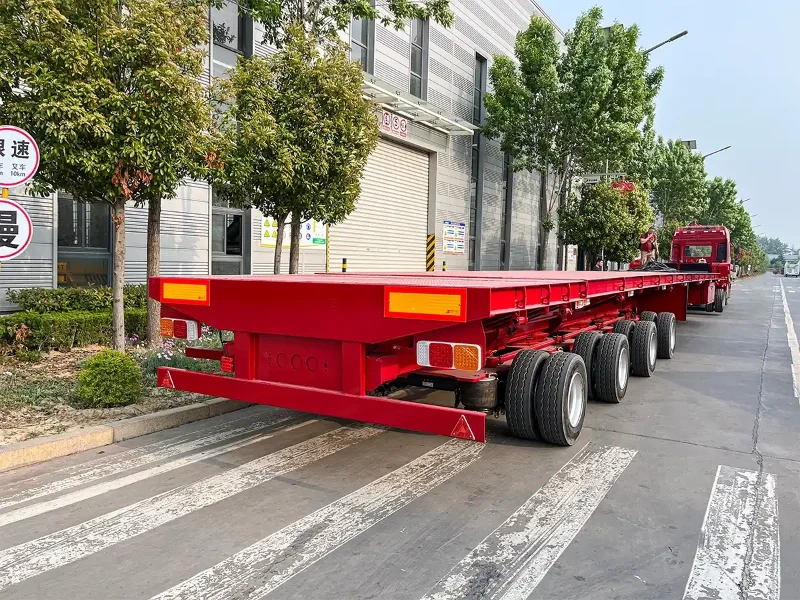
A main street drawn for cars, not blades
The highway is rarely the hard part-the towns it cuts through are. A blade longer than 70 metres has to thread its way down streets built for cars and motorcycles, beneath power lines and shop signs and around sharp corners. The convoy moves at a crawl, often after dark, edging past obstacles that were never designed with a turbine blade in the equation.
The answer starts with length that changes to suit the road. An extendable truck trailer deck telescopes in and out, so the convoy runs shorter through built-up streets and extends only when the road opens up. At the front, the blade root sits on a rotating hydraulic adapter; instead of the blade sweeping a fixed arc around every corner, the operator can turn and lift the tip to steer it past a roofline or a wire, while hydraulic multi-axle steering lets the rear of the convoy follow rather than cut wide.
The hairpin the surveyors flagged twice
The second problem is the bend that a rigid, long vehicle simply cannot make. On the climb to the ridge, the surveyed route includes several tight switchbacks with outside slopes and rock faces. A fixed trailer would either mount the verge or force the road to be widened at every turn.
This is exactly where the rotating adapter earns its place, because no amount of extra deck length can solve it. At each switchback the blade is swivelled and raised on its root support, freeing it from the chassis it would otherwise follow like a rigid tail; the blade arcs through the turn above the carriageway as the trailer tracks the curve beneath it.Self-steering axles tighten the turning circle, and the entire maneuver is planned from the same survey notes that marked the bend in the first place.
The main street that was never measured for this
The first problem is not on the highway; it is in the towns the highway passes through. A blade over 70 metres long has to move along streets laid out for cars and motorcycles, past utility wires, shop signs and tight corners. The convoy travels slowly and often at night, negotiating obstacles that were never designed with a turbine blade in mind.
The answer starts with length that changes to suit the road. An extendable truck trailer deck telescopes in and out, so the convoy runs shorter through built-up streets and extends only when the road opens up. At the front, a rotating hydraulic adapter holds the blade root. That means the blade no longer traces the same rigid arc at every corner; the operator can rotate the root and raise the tip, walking the blade over a roofline or under a wire. At the same time, hydraulic multi-axle steering makes the rear of the convoy track the tractor instead of swinging wide.
The hairpin the surveyors flagged twice
The second problem is the bend that a rigid, long vehicle simply cannot make. On the climb to the ridge, the surveyed route includes several tight switchbacks with outside slopes and rock faces. A fixed trailer would either mount the verge or force the road to be widened at every turn.
Here the rotating adapter does the work that a longer deck cannot. On each switchback the blade is pivoted and tilted up on its root support, so the long, fragile blade no longer behaves like an extension of the chassis; it swings through the corner above the road while the trailer itself follows the curve. Self-steering axles tighten the turning circle, and the entire maneuver is planned from the same survey notes that marked the bend in the first place.
The red grade that won't hold this weight
By the third problem, the road has effectively run out. The last approach to the ridge is a red laterite track that turns to dust in the dry season and to grease after rain, climbing over gradients and across small culverts that were built for farm trucks rather than a heavy 70-metre load. Put that weight on too few axles and the convoy simply sinks-or the culvert does not.
The load is therefore spread across many axles rather than concentrated on a few, the same load-spreading principle used in our multi-axle truck trailer designs for heavy project cargo. More contact points keep ground pressure low on soft climbs and bring axle loads within the bridge limits the surveyors recorded, while the deck retracts for the empty return leg.
The wind waiting on the ridge
The fourth problem is the reason the project exists: wind. A raised blade is a sail. On the ridge, crosswinds can be strong enough to make a suspended blade unsafe to move, so the adapter locks the blade at a chosen angle and the convoy works to weather windows rather than a fixed timetable. Moving in the calmer hours, and securing the blade in its cradle when the wind rises, turns a hazard into something the crew can plan around.
Built from a route survey, not a catalogue
None of these trailers was picked off a shelf. Every unit started life as a set of measurements from the customer's route survey-the street widths through each village, the turning radius of every bend the surveyors flagged, the uphill grades and the per-axle limits posted on each bridge, the clearance beneath the overhead wires, and the exact location of the pads.Those numbers set the telescoping length, the axle count, the steering arrangement and the lift angle. For shipment, the decks, adapters and axle lines were broken down for breakbulk and roll-on loading, then reassembled and commissioned on arrival, with hands-on training for the operating crews.
If you are building a wind project-or moving any over-length, over-height or over-weight piece along difficult roads-send us the cargo dimensions and your route survey, even just photos of the key bends, gradients and bridge signs. We will configure the telescoping length, axle count, steering and lifting solution around your actual route and return a layout and a quotation that fits the road rather than the other way around.