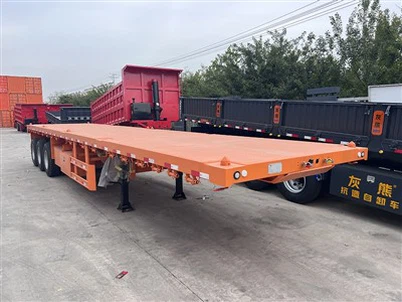
Tri-Axle 40ft Dual-Use Flatbed Trailer — Container Twist Locks and General Cargo Backhaul Platform

Tri-Axle 40ft Dual-Use Flatbed Trailer — Container Twist Locks and General Cargo Backhaul Platform

Tri-Axle 40ft Dual-Use Flatbed Trailer — Container Twist Locks and General Cargo Backhaul Platform

Tri-Axle 40ft Dual-Use Flatbed Trailer — Container Twist Locks and General Cargo Backhaul Platform
Tri-Axle 40ft Dual-Use Flatbed Trailer — Container Twist Locks and General Cargo Backhaul Platform
Tri-axle 40ft dual-use flatbed with optional 20/40ft container twist locks and a bare general cargo deck for backhaul loads. Q345 frame, side tie-down rings, configurable suspension and deck. Factory direct.
Type: semi trailer
Grade: heavy duty
Number of axle: 2,3,4 etc(customized as your requirements)
ABS: optional
Certification:CE, ISO9001, CCC (Other types of certifiates also available)
Contact us for more infos.
Description
This tri‑axle 40ft dual‑purpose flatbed is a versatile platform. On outbound runs, it secures 20ft or 40ft containers via twist locks; for return trips, the open deck can haul steel, timber, prefabricated components or machinery skids.Three 13 t axles, 13,000 × 2,550 mm deck, Q345 main frame.
The difference from a container-only skeleton is this: the deck is a full platform floor, so the trailer does not run empty after the container is delivered.

Benefits of Dual‑Use Functionality
A container-only chassis optimizes one job. In African, Southeast Asian and Central American corridors, the container leg is often matched by a return leg that is not a container - steel sections from the port, timber from a sawmill, precast pieces to a construction site, machinery skids from a supplier's yard.
- Outbound: container sits on twist locks at the four corner positions and optional mid-position locks.
- Return: twist locks leave the deck; chains and straps tie the bare load to the deck D-rings.
- The same trailer serves both haulage legs; the backhaul produces income instead of travelling unladen.
The trade-off against a dedicated skeleton: the full deck and its floor add tare weight. If every load you carry is a container, a skeleton frame is lighter and cheaper. If your return corridor carries bare cargo, the dual-use flatbed earns that weight back on the backhaul.
Before You Order: The Specification Fields to Confirm
This flatbed is built to the route and the cargo, not to a single default spec. These are the fields our engineers confirm before production.
| Field | What we need to know | Why it changes the build |
|---|---|---|
| Main cargo | Container, steel, timber, skids, or mixed | Decides twist lock count, deck floor and tie-down layout |
| Container size | 20ft, 40ft, or both | Lock positions differ; both sizes need the full 12-lock set |
| Return cargo | Max bare cargo weight, dimensions, overhang status | Deck beam spacing, side rails and front headboard spec |
| Route conditions | Highway, gravel road, or mixed | Mechanical vs air suspension, tire pattern |
| Axle weight rules | Destination country legal axle load | Axle quantity, tire size, GVW rating |
| Weather exposure | Coastal salt spray, dust, rainy season | Paint system and under-deck protection |
Send the cargo list and the country of registration; we mark the spec sheet before the frame is cut.
Configuration Options
| Option | Specification | When to choose |
|---|---|---|
| Twist locks | 12 positions, 20ft + 40ft compatible | Any container leg in the schedule |
| Deck floor | Steel checker plate, or Apitong hardwood | Steel for mixed cargo; hardwood for track machinery and painted loads |
| Suspension | 10-leaf mechanical, or air suspension | Mechanical suspension for rough roads; air suspension for sensitive cargo and long hauls |
| Front headboard | Welded steel wall, 400–600 mm | Loads that can slide forward under braking |
| Side rails / stakes | Removable stakes in pockets | Bundled timber, pipe, stacked sections |
| Toolbox | Sealed steel under-deck box | Chains, straps, dunnage, spare parts |
| Spare tire carrier | Rear or under-deck mount | Remote routes without tire service |
Specifications (Tri-Axle 40ft Base Build)
| Item | Specification |
|---|---|
| Deck Length × Width | 13,000 × 2,550 mm |
| Rated Payload | 30–40 t (per destination axle rules) |
| Main Beam | Q345, I-section, 500 mm beam height |
| Deck | 8mm checker steel plate on cross-members |
| Twist Locks | 12 positions optional, 20ft / 40ft |
| Tie-Down Rings | 16 D-rings, 8 per side, 2.0 t each |
| Axles | 3 × 13 t FUWA / BPW |
| Suspension | 10-leaf mechanical; air optional |
| Brakes | Dual-line air, ABS |
| Tires | 12R22.5 × 12 |
| King Pin | JOST 3.5" |
| Landing Gear | 28 t two-speed JOST |
| Curb Weight | ~7,200 kg (steel deck, twist locks) |

Securing a Bare Return Load
Without a container, the deck carries the load directly. Three rules apply to every bare load.
Tie to deck rings, not the side rails. he D-rings are welded directly to the main frame cross beams. The side rails and front headboards serve as protective barriers and are not designed as the main load securing points.Chains run forward and rearward on both sides, with corner protectors where they touch painted steel.
Dunnage spreads concentrated weight. A machinery skid or a bundled coil sits on wooden blocks so its contact pressure spreads across several cross-members, not one beam line.
Headboard for front-positioned loads. Anything that can slide forward under hard braking - bundled pipe, sections, a skid - rests against the front headboard. If the load is tall or wide, stake pockets and side stakes contain the sides.
Related Models and Delivery Info
A container-only schedule with no bare backhaul is served more lightly by a 40ft container skeleton. Longer over-width or over-length cargo moves to the 60ft flatbed or 48ft flatbed. The stake-and-board construction for building-material loads is detailed on the 3-axle 40ft flatbed. The full platform range is on our flatbed semi trailer page.
Share what cargo you carry outbound and on backhaul, your container sizes, and the local axle load regulations in your destination country. Our engineering team will finalise twist lock placement, deck flooring and suspension specifications before issuing your quotation.
Each trailer ships with chains, corner protectors, dunnage blocks, toolbox and a lashing drawing for the stated loads. Lead time is 25 working days from deposit, plus sea freight to your nearest port.
FAQ
Q1: Does this trailer handle 20ft and 40ft containers?
A: With the full 12-lock set, yes. The 20ft locks use the middle pair of positions; 40ft uses the four corners plus mid locks. Specify both sizes at order time so the lock positions are drilled in the right places.
Q2: Is the flatbed heavier than a skeleton?
A: Yes, its tare weight is around 800–1,200 kg higher due to the continuous deck and cross-members. This extra weight enables backhauling non-container cargo. If you only haul containers on every run, a skeletal trailer will be the lighter option.
Q3: What deck floor should we choose for steel loads?
A: Steel checker plate. Hardwood is for machines with soft track pads or painted loads that mark easily; repeated steel section drag wears hardwood down fast.
Q4:Is the front headboard standard?
A: It is an option, chosen when your bare loads can slide forward. If you only carry containers and strapped pallet cargo, it can be omitted to save tare and cost.
Hot Tags: Tri-Axle 40ft Dual-Use Flatbed Trailer — Container Twist Locks and General Cargo Backhaul Platform, China Tri-Axle 40ft Dual-Use Flatbed Trailer — Container Twist Locks and General Cargo Backhaul Platform manufacturers, factory, 3 Axles 40ft Flatbed Trailer, 40 Ton Flatbed Truck, Flatbed Container Trailers, 50 Ton Flatbed Trailer, 60 Ton Flatbed Trailer, Flatbed Truck Trailer
Send Inquiry
You Might Also Like